
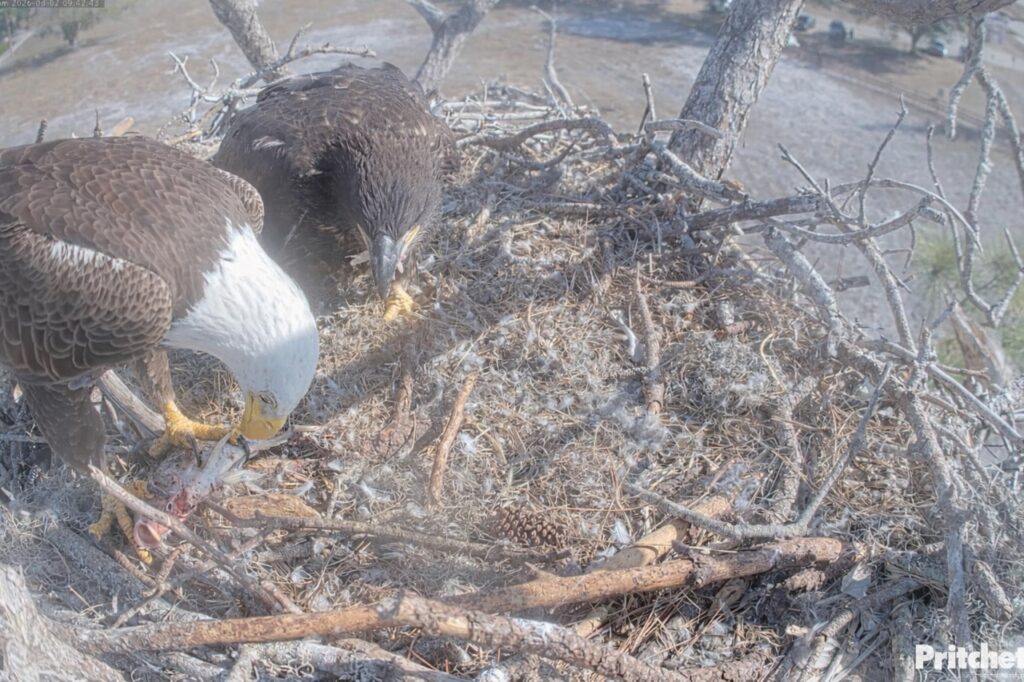
There are moments at a nest when the air shifts, and everyone watching can feel it. At the Southwest Florida eagle nest, that shift came quietly. Eagle mom, F23 has not been seen since the morning of February 27. No dramatic exit. No visible struggle. Just vanished. And in that absence, the weight of the nest changed.
Watch Live ← Nest Cam
Now, as of today March 2, 2026, Eaglet E26 is 74 days old, standing on the edge of fledging season. Wings stretch longer. Hops turn into lift. The sky is no longer a distant ceiling but an invitation. And beside the eaglet, steady and strong, is Dad M15, doing what must be done. He is raising E26 alone.
Receive updates like this one in your inbox. Sign up for our newsletter. 🦅
The Silence After February 27
When a swfl resident eagle like f23 seemingly vanishes from its nest, there is usually no instant explanation. Nature does not issue statements. The camera keeps rolling. The nest remains. The waiting begins.
F23 was last observed at the nest on the morning of February 27. Since then, she has not returned to camera view. In the days that have followed, viewers have been watching closely for a familiar glide toward a nest branch, a landing on the nest rim or a familiar shadow crossing the pine needles. It has not yet happened.
M15 Steps Fully Into the Role
Bald eagle parenting is a partnership. Two adults share hunting, guarding, and guiding. But when one is absent, the other does not hesitate. Instinct takes over.
M15 has been delivering food, standing watch, and remaining present for E26 as fledging approaches. The timing makes this especially significant. At 74 days old, E26 is strong, feathered, and nearly ready to launch. But this stage still requires protection and consistent provisioning. The rhythm of the nest continues because M15 continues.
Those who have followed this nest for years understand the gravity of this moment. But the focus now is not history. It is the present. It is one parent and one nearly fledged eaglet navigating uncertain days together.
E26 Nears the Sky
Seventy-four days is a powerful milestone in an eagle’s life. By now, muscles are strong and flight feathers are fully formed. And slowly but surely, the instinct to leave the nest begins to compete with the instinct to stay.
Fledging can happen quickly once those wing exercises turn into lift. When E26 does take flight, it will mark a turning point. Not just because it’s a milestone, but because of the circumstances surrounding it.
This young eagle is on the brink of independence, guided now by a single parent.
And yet, he looks strong, confident and is growing by the day.
What Happens Next?
At this point, there is no confirmed information about F23’s whereabouts. In wildlife situations, speculation spreads easily, especially when a beloved bird is involved. The most responsible course is patience and verified updates.
If anyone believes they have seen an injured bald eagle in the area, the correct action is to contact licensed wildlife rehabilitators or local authorities directly with exact location details. Quick reporting gives trained professionals the best chance to respond appropriately. Beyond that, we wait. Nature sometimes returns what seems lost. Sometimes it does not. The nest does not pause for answers.
For now, the camera shows M15 on guard. E26 stretching toward the sky. A family in transition.
And an entire community hoping that one familiar silhouette will appear on the horizon.
FAQ
Why did f23 vanish from the SWFL nest?
It is not yet known what happened to F23. She was last seen on the morning of February 27, 2026.
How old is E26 right now?
E26 is 74 days old as of March 2, 2026, and therefore is nearing the typical fledging window for bald eagles.
Who is caring for E26?
M15 is currently caring for E26 alone while F23 remains missing.
Is E26 close to fledging?
Yes. Now that E26 is 74 days old and in the late pre-fledge stage, he could take his first flight in the coming days or weeks.
What should I do if I see an injured bald eagle?
If you have seen an injured bald eagle, please immediately contact a licensed wildlife rehabilitator or local wildlife authorities and be sure to provide the exact location and time of the sighting.


