
Live Bald Eagle Cams
| Texas Eagle Cam active Nov-Mar | |
| KNF Eagle Cam active Dec-April | Hays Eagle Cam active Jan-May |
| USS Eagle Cam active Jan-May | Decorah Eagle Nest active February – June |
| Berry Eagles active January – May | SW Florida Eagle Nest active November – March |
| Big Bear Eagle Nest active late Jan – July | Decorah North Nest active February – June |
| Notre Dame Bald Eagles active February – June | Duke Farms Eagles active January – May |
| MN DNR Nest active February – June | NCTC Eagle Cams active February – June |
| Fort St. Vrain Eagles active February – June | more Live Wildlife Cams |
Live Post Comments:
-
 😔 Read moreon Gunshots at Big Bear Startle Shadow, Then a Second Bang Sends Him Into High Alert
 -
Maybe it's time to let us go and bring back the dinosaurs. Read more
-
It's the most despicable thing a human can do...shoot an animal with a high powered (or any) rifle. … Read more
-
Sad and terrifying...😣 Read more
-
SO DISGUSTING. WHY WOULD YOU KILL A BEAUTIFUL ANIMAL, BAMBIS MOTHER. LETS SEE HOW YOU WOULD FEEL IF … Read more
-
DISGUSTING SPORT...KILLING OF HARMLESS ANIMALS AND SCARING THE REST Read more


SPO Signup
GET UPDATES, DISCOVER NEW CAMS, IT’S FREE!
About Bald Eagles
Once a plentiful species, the Bald Eagle was selected as the national bird of the United States in 1782, but, the population of this magnificent bird dropped drastically in the 20th century due to the use of pesticides, overhunting and pollution of rivers. However, a successful recovery plan was created, and it is currently proposed for removal from the endangered species list. This listing provides you the ability to view nests from all over the United States and experience the regrowth of this wonderful species.
How to tell the difference between male and female?
The female Bald Eagle is larger in size and her wingspan is longer. Also, her back talon(hallux talon) is longer, and she has a bigger, longer beak. In fact, the beak may even start behind her eye whereas the male beak may not. While watching the Bald Eagle Cams you will notice a sizeable difference between male and female.
Physical Characteristics
Length: 28 – 38 in (71-96cm)
Weight: 6 1/2 – 14 lbs (3.0-6.5kg)
Migration: Partial migrant
Habitat: Nearby water, including rivers, as well as lakes and coastal locations up to an altitude of 6,500 ft.
Population: Scarce
Population and Growth:
Currently, its been estimated that over 6,000 mating pairs of Bald Eagles breed in the lower 48 states and far more than that in Canada and Alaska. In fact, some the the organizations who set up and maintain these Bald Eagle cams track the population and growth of their local Bald Eagle population.
How big are Bald Eagle eggs?
Bald Eagle eggs are about the size of a tennis ball, but oval shaped like an egg normally is of course. A bald eagle egg weighs 120-130 grams. For example, a large chicken egg weighs about 50 grams. (28 grams = 1 ounce) While watching the Bald Eagle cams you will often get a close up view to see the eggs in more detail during zoom sessions.
Winter Feeding Information:
From the time they hatch to the time the young Bald Eagles fledge is about 10 to 13 weeks. Of course, the Bald Eagle cams follow this process from start to finnish.
When will the baby eaglets take their first flight?
During the winter large numbers of Bald Eagles gather at the spawning grounds of salmon, trout and other river fish. These Bald Eagles compete against other predatory birds and bears for the dead and dying fish. Some of the Bald Eagle cams have PTZ cams which allows them to focus on areas other than the nest.
Which Eagle Hunts For The Food?
They both hunt. The female might be on the nest more often when brooding..
Are the cameras that are used on the eagles nest, shining a light on the eagle all night long?
Indeed, they do have a cam light shining on them all night long. However, the cameras light is called infrared and can’t be seen by humans or animals. Only cameras can pick it up. For example, if you walked out to that nest at night it would look pitch black outside. In fact, almost every Bald Eagle cam has this feature.
What the Bald Eagle looks like:
The adult Bald Eagle is unmistakable due to the prominent white head, yellow eyes, bill and feet which contrast the dark brown of its wings and back. However, the juvenile’s plumage is not as recognizable as adults and some times can be mistaken as a Golden Eagle. Moreover, the juvenile will develop into its full adult plumage at 4 years of age. Of course, the more you watch Bald Eagle cams, the more you will learn about how to tell the difference between a male and female Bald Eagle. Reading the comments section below each live cam or asking questions is also another great way to learn about Bald Eagles.
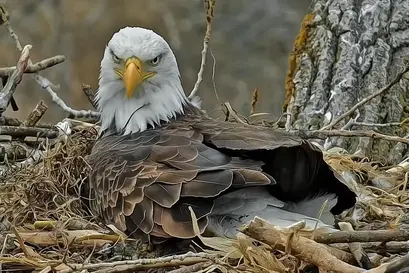
What happens to all the inedible stuff?
Most of the stuff that isn’t eaten – feathers, bones, etc. will remain in the nest.
Interesting Fact:
Bald Eagles really aren’t bald like it’s name portrays, but gets that title because it’s head is covered with white feathers which gives the impression of baldness when compared to it’s dark feathered body.
See a range map showing where bald eagles reside at allaboutbirds.org
Latest Posts:
- Gunshots at Big Bear Startle Shadow, Then a Second Bang Sends Him Into High AlertShadow’s first stick of the season brought hope to the Big Bear nest. Then two loud gunshots startled him, sending him flying to Lookout Snag. See what happened and how both eagles are doing.
- Shadow and Kaydee Greet the Morning Together as Big Bear Nesting Season NearsShadow and Kaydee began October 7 together with beautiful chortles before dawn. Then they flew to Lookout Snag, where they shared another sweet moment as a new Big Bear nesting season approaches.
- SWFL Eagles M15 Brings Home Prey, Then Spends Nearly 2 Hours at Nest TreeM15 spent nearly two hours around his Southwest Florida territory on October 6, bringing prey to the office oak, visiting the pond and settling into the familiar nest tree.
- Shadow Waits for Kaydee at Big Bear, Then Suddenly Gets Busy at the NestShadow appeared to be keeping a close eye on Kaydee from the Big Bear nest. Then she took off from Twin Pines, and his next move made the moment even sweeter.
- Decorah Eagle DH3 Released to the Wild After SOAR RehabAfter months of rehabilitation, Decorah Eagle DH3 is flying free again. Watch the unforgettable moment the young bald eagle leaves his crate and returns to the wild.
- SWFL Eagles: M15 May Be Building a Second NestM15 continues to visit the familiar SWFL Eagles nest tree, but activity elsewhere may suggest he and the new female are exploring a second nest location for the new breeding season.
- Kaydee Brings Another Tiny Stick to Big Bear, Then Shadow Nibbles BackKaydee brought another tiny stick to the Big Bear nest, but the sweetest moment came afterward when Shadow surprised her with a quick feather nibble in return.
- Shadow Appears to Make His First Mating Attempt With Kaydee, Then a Side Kick Sends Him FlyingShadow appeared to make his first mating attempt with Kaydee at Big Bear, but the brief interaction may have been something else. Then Kaydee delivered a side kick that sent Shadow flying and turned the evening into one unforgettable encounter.
- Kaydee and Shadow Defend Her Fish From Eagle Intruder in Big Bear ChaseKaydee had barely started eating her fish when a young bald eagle came after it. What happened next put Kaydee and Shadow’s growing teamwork on full display.
- Bald Eagle M15 and New Female Visit SWFL Nest as M15 Moves SticksA rainy September day brought more activity to the SWFL eagle nest as M15 moved sticks and the new female spent time on the veranda.
- Red-Tailed Hawk Dive-Bombs Shadow Twice at Big Bear, but He Stays PutShadow and Kaydee began the day with chortles and a familiar little routine. Hours later, a red-tailed hawk came straight at Shadow twice.
- SWFL Eagles: M15 Flies With New Female, Hauls Huge BranchM15 has company in the sky—and an ambitious choice of nesting material. A flight with a new female brings fresh hope as he stays busy near the nest.
- Kaydee Brings Her First Stick to Big Bear Nest, Then Showers Shadow With Beaky KissesThe stick was tiny. The moment was not. Kaydee carried her first stick into the Big Bear nest, then greeted Shadow with a burst of beaky kisses.
- Kaydee Is Back at Big Bear, and She Went Straight to ShadowAfter some time out of camera view had eagle watchers worried, Kaydee returned to Big Bear and quickly found Shadow. What happened next on Lookout Snag brought some much-needed smiles.
- Shadow and Kaydee’s Courtship Behavior Takes Another Step Forward at Big BearShadow and Kaydee shared their most playful Big Bear nest visit yet, complete with beakies, feather nibbles, a duet and one stick Shadow simply had to put back.
- Kaydee Finds Shadow and Makes Bold Move After Big Bear Nest MakeoverKaydee came to the Big Bear nest with sticks on her mind. After winning a battle with one stubborn branch, she found Shadow and made an even bolder move.
- Many Bald Eagle Nests Go Quiet as Florida’s Nesting Season StirsBald eagle nests are growing quieter as young eagles range farther from home and fall migration begins. In Florida, the first signs of a new nesting season are already appearing.
- Visitor Bald Eagle Returns to U.S. Steel Nest 4 Days in a Row. What Could It Mean?A visitor bald eagle returned to the U.S. Steel nest four days in a row, while a subadult was also seen near Irv. Here’s what the late-summer visits could mean.
- Shadow Reappeared on Big Bear Cameras After Nearly a Day AwayFor almost a full day, Kaydee kept returning to the Big Bear cameras without Shadow. Then at 9:06 Saturday morning, one familiar white head finally appeared again.
- Shadow Spends More Than an Hour at Big Bear Nest, Then Kaydee Shows UpShadow settled into the Big Bear nest for more than an hour Tuesday evening, giving viewers a beautiful extended look at him. Then he left, and Kaydee showed up soon afterward.
What is a pip?
A pip hole is a tiny hole that the eaglet inside the egg makes with its “egg tooth” (a sharp little point at the end of its beek) in the outside shell when it first starts to hatch.