
Big Bear pip watch starts March 31 for egg #1, placing the nest at the doorstep of one of the most important stages of the season. Day 35 does not promise that a visible pip will appear right away, but it does mark the point when the timeline begins to narrow. Big Bear eagle eggs typically hatch around 37 to 40 days after laying, and after a first visible pip, hatching often follows within 24 to 48 hours. With that window now approaching, even the smallest changes at the nest begin to matter more.
Watch Live <—— nest & approach cams
The past week has kept that window firmly in sight. Jackie and Shadow have continued their incubation exchanges, rolled the eggs often, added fresh fluff to the bowl, and brought in well-placed sticks. Fish gifts have arrived at the nest, and spring has continued unfolding across Big Bear Valley. At the same time, intruder pressure has not let up. Several disturbances forced both eagles to break from the nest to drive ravens from the area, leaving the eggs unattended for short periods before incubation resumed.
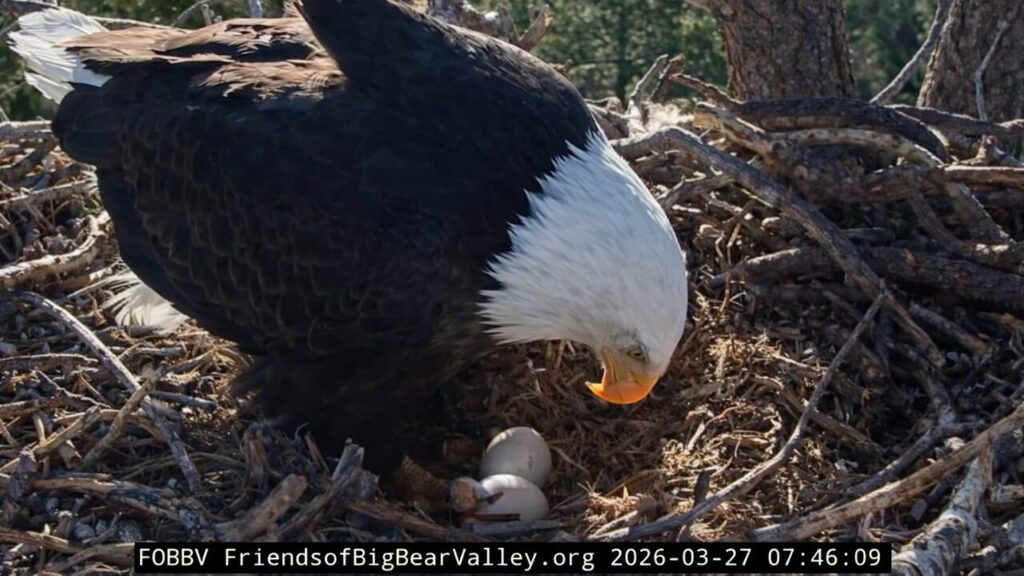
Why March 31 matters at the Big Bear nest
March 31 matters because it marks day 35 for egg #1. Bald Eagle eggs on average PIP after 35 days of incubation.
At Big Bear, that date carries weight because the eggs typically hatch around days 37 to 40.
Nothing needs to happen instantly for the nest to enter a more important stretch. The calendar alone changes the meaning of ordinary nest activity.
A careful exchange over the bowl is no longer just routine. An egg roll no longer looks like a small moment that comes and goes unnoticed. A pause over the eggs can suddenly seem more revealing than it did a week earlier. That is what makes pip watch different. The nest is still doing what it has been doing, but now each detail sits closer to the hatch window.
Receive updates like this one in your inbox. Sign up for our newsletter. 🦅
Signs a hatch could be near
The earliest signs are often subtle. A pip is the first small crack or hole in the shell, but before that becomes clearly visible, the nest may show quieter clues through behavior and timing.
One possible sign is increased attentiveness over the bowl. Jackie or Shadow may pause longer before incubating, lower into the bowl more carefully, or angle their head downward more often.
None of those moments confirms a pip on its own, yet together they can suggest that the nest is moving into a more delicate stage.
Incubation exchanges can also become more telling during this period. When one parent takes over, the movement into the bowl may look especially deliberate. The settling may be slower, and the repositioning may be more careful. At times, the parent may use its beak to work into the bottom of the nest bowl, then pause in a way that makes it seem as though it is listening for sounds coming from an egg or eggs. That kind of handling can stand out as one of the subtle signs that hatch time may be drawing close.
Egg rolls matter too. They are a normal part of incubation, but this close to hatch time they draw more attention because they can briefly reveal the shell and bowl area before the parent settles again. At first, the shell may still appear unchanged, especially depending on the light and camera angle, but repeated glimpses can offer a better look at any possible changes in the eggshell.
This week’s nest activity has kept the focus on the eggs
The nest has not been still this week. Fresh fluff has been brought in and worked into the bowl, making the center of the nest look softer and more prepared. Sticks have also been added with care, helping maintain the shape and structure around the bowl area.
That kind of nest work is normal, yet near pip watch it carries more weight. The bowl has been tended again and again. Jackie and Shadow have kept up the steady maintenance that defines this part of the season, and the nest reflects that constant attention.
Fish gifts have also been part of the week’s rhythm. Food deliveries are part of the pair’s partnership and help reinforce the steady pattern of care around the eggs. Each arrival, each exchange, and each return to the bowl has added to a week that looks less like a pause and more like a lead-in.
Intruder activity has added pressure before pip watch
Alongside the quieter nest work, intruder activity has remained steady leading to PIP watch at the Big Bear nest. Several events sent Jackie and Shadow after ravens, forcing both eagles off the nest for short periods. Those departures were brief, but they added tension to a week that already carried growing importance.
Even with those interruptions, the larger pattern held. The eggs were rolled. The bowl was fluffed. The exchanges continued. Incubation resumed. The nest kept moving forward through each disruption, and that has become part of the story too. The approach to pip watch has unfolded under pressure, not in perfect calm.
That contrast has shaped the week. One moment brings fresh nest material and careful bowl work. The next brings a sudden burst of defense overhead. Then the pair returns to the eggs and settles back into the work that matters most.
The smallest moments may matter most now
Near hatch time, the nest does not always announce change in a dramatic way. Sometimes the first signs are easy to miss. A longer pause over the eggs. A slower settle into the bowl. A slightly different posture during an exchange. A brief glimpse during an egg roll that leaves more questions than answers.
That is why March 31 matters even before a visible pip appears. Big Bear pip watch begins not with certainty, but with the possibility that the nest may start revealing more through its smallest details. The shell may not show an obvious opening right away, yet the activity around it can still begin to shift.
Jackie and Shadow have spent the week doing exactly what this stage demands. They have protected the nest, maintained the bowl, handled exchanges, brought in fresh material, accepted fish gifts, and continued incubation through repeated interruptions. Now the calendar reaches day 35, and the nest moves into the stretch where signs a hatch could be near may begin appearing at any time.
FAQ
When does Big Bear pip watch start?
Big Bear pip watch starts on March 31 for egg #1, which marks day 35.
How long do Big Bear eagle eggs usually take to hatch?
Big Bear eagle eggs typically hatch around 37 to 40 days after laying.
How long after a visible pip does hatching usually happen?
After a first visible pip appears, hatching often follows within 24 to 48 hours.
What are signs a hatch could be near?
Possible signs include increased attentiveness over the bowl, more careful incubation exchanges, repeated egg rolls, subtle changes in how Jackie or Shadow settle over the eggs, and any visible changes to the eggshell. At times, a parent may also dig gently into the nest bowl with its beak, then pause in a way that makes it appear to be listening for or reacting to something coming from beneath them, possibly from one of the eggs.
Has a pip already happened at the Big Bear nest?
This post does not report a confirmed pip. It explains the signs that could suggest a hatch is getting closer as Big Bear pip watch begins.


Thank you so much for this very informative article on what to look for as pip watch starts today. March 31, 2026. I am looking forward to observing Jackie and Shadow exhibit the signs of pending pip such as increased attentiveness to the bowl, more careful positioning in exchanges, and visible egg changes. Can’t wait for new developments! 😃 🐣