
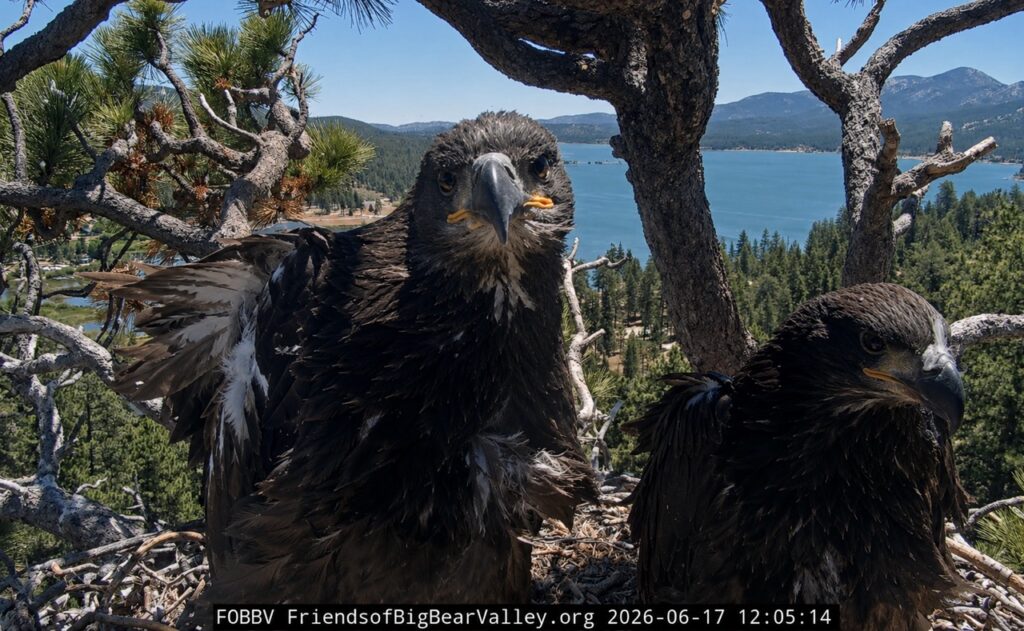
On June 17, 2026, at Jackie and Shadow’s Big Bear eagle nest in Big Bear Valley, California, one question is on every viewer’s mind: What happens to Sandy and Luna after they fledge? After weeks of wingercizing, branching, balancing, fish stealing, sibling squabbling, and those unforgettable eaglet voices, their first true flight is almost here.
Watch Live <—— nest & approach cams
For viewers, fledging can feel like the grand finale. It is the moment everyone waits for, worries about, and secretly wants to delay just a little longer. One leap. One burst of wings and one young bald eagle leaving the nest where so many people have watched them grow from tiny, bobble-headed chicks into strong young eagles.
But for the Big Bear duo, that leap is not a neat ending. It is the first page of a much bigger story.
Once those talons leave the nest, everything begins to change. The young eagles will have to learn how to fly with control, how to land without turning the forest into a feathered circus act, how to find food, how to read the landscape, and eventually how to live without their parents managing every meal and every moment.
Receive updates like this one in your inbox. Sign up for our newsletter. 🦅
That is why this stage feels so emotional. Sandy and Luna have become part of the daily rhythm for so many Big Bear eagle fans. Their sounds, their antics, their growth, and their very different personalities have turned two wild eaglets into birds people truly care about.
The First Flights May Look Messy
It is tempting to imagine the first flight as a flawless eagle masterpiece. One brave hop, one powerful flap, and suddenly a graceful young bald eagle sails across Big Bear Valley like it has been doing this for years.
That would be lovely. It is also not usually how this works. Young eagles spend weeks preparing for flight, but preparation is not the same as open air. Wingercizing builds muscle. Branching teaches balance and confidence. Hopping around the nest tree helps them understand their bodies. But the first real departure from the nest is a completely different challenge.
These early flights are often short. Very short. Rather than soaring across the sky, a fledgling may glide to a lower branch, land somewhere awkward, or spend time figuring out how to move from one tree to another without looking entirely sure who approved this activity. To a viewer, a clumsy landing can look scary. To a young eagle, it is part of the learning process. A first flight does not have to be pretty to be successful. It only has to begin the next stage.
The Nest Tree Becomes a Practice Zone
In the days after fledging, the nest area often changes from a nursery into a training ground. The young eagles may spend more time perched in nearby trees, calling for food, testing their wings, and figuring out how to move through the branches.
The nest itself will still matter, but it is no longer the whole world.
That is one of the biggest changes viewers may notice. Instead of seeing both eaglets tucked together in the nest bowl, there may be more movement around the territory. One may be on a branch and one may be off-camera. One may return for food and one may call from somewhere nearby and make everyone stare at the screen as if the trees might start explaining themselves.
This stage can feel uncertain, but it is exactly what should happen. The fledglings need room to practice. They need nearby trees, safe perches, and repeated attempts at the basic skills they will use for the rest of their lives.
Jackie and Shadow Will Still Have Work to Do
Fledge day does not mean the adults clock out and start a quiet retirement filled with lake views and nest renovations. Jackie and Shadow will likely continue providing food after the first flights. Young bald eagles usually enter a post-fledging dependence period, which means they can fly but are not fully independent yet. They still need their parents while they learn the skills required to survive.
That is especially important because hunting is not automatic. A young eagle has to learn where food is likely to be, how to approach it, how to grab it, and how to keep it. Catching fish takes timing, strength, judgment, and experience.
That is a lot to ask from a bird that may still be mastering the art of not landing like a thrown laundry basket.
Fortunately, these two have excellent teachers. Jackie and Shadow have shown again and again that they know how to feed a family. The adult pair has brought in impressive fish, handled rough weather, defended the nest, and raised the eaglets through one demanding stage after another. For Sandy and Luna, that means the first weeks after fledging will be part flight school, part hunting school, and part family dinner with louder vocals.
Failure Is Part of Eagle School
At some point, the fledglings will begin trying to find food on their own. Their first attempts may not go well. That is expected.
Young eagles learn by repetition. They may chase food they cannot catch and they may investigate scraps or carrion. They may scavenge when the opportunity appears. Bald eagles are opportunistic hunters and scavengers, which means they use available food sources instead of relying on one perfect hunting method.
That may not sound glamorous, but in the wild, survival is not about looking dramatic. It is about staying fed. Every awkward landing, missed grab, watched meal, and parent-delivered fish becomes part of their education. Sandy may bring that bold, food-focused energy into the next chapter. Luna may bring the persistence viewers have watched grow day by day. Both young eagles have already shown strength, personality, and determination in the nest. After Sandy and Luna fledge, those traits matter even more.
What About Gizmo, Sunny, and the Eagles From Past Seasons?
Watching this year’s eaglets approach fledging naturally brings back memories of the young eagles who came before them. Gizmo and Sunny are part of that bigger Big Bear story. So are the other eaglets viewers still wonder about after they leave the cameras. Once young eagles move into independence, it is natural to imagine where they might be, what they are learning, and whether they are still somewhere out there exploring the world that began for them in Big Bear.
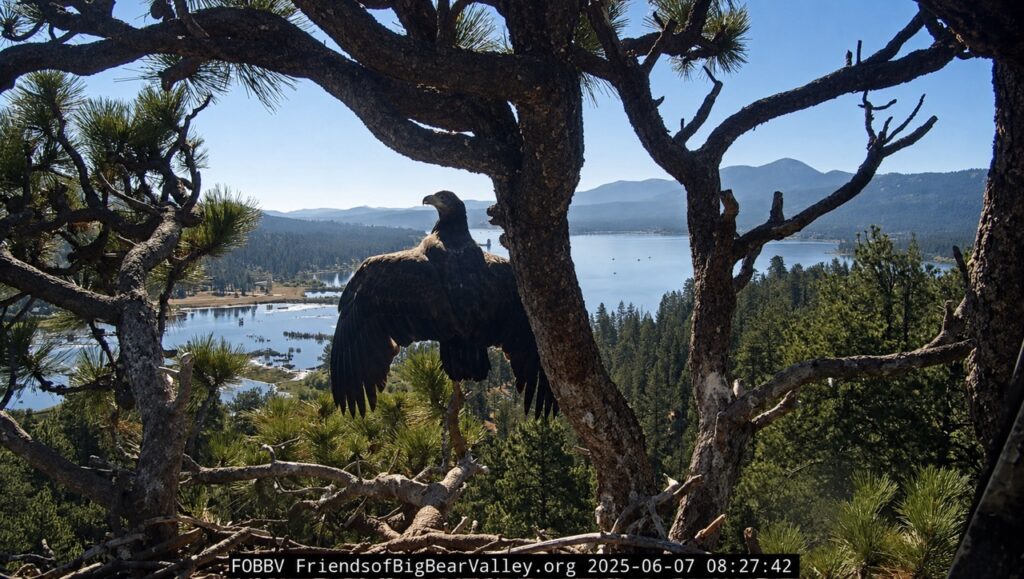
That is one of the hardest parts of nest-cam watching. We get such an intimate beginning, then the rest of the story moves beyond our view. But those unseen years are not empty. They are the years when young eagles learn the land, follow food, survive weather, and become the birds they were hatched to be.
Their Appearance Will Change for Years
Right now, Sandy and Luna do not look like the bald eagles most people picture. They have dark juvenile feathers, dark eyes, and darker beaks. They are bald eagles, but they do not yet have that famous white head and tail.
That transformation takes years. Juvenile bald eagles slowly change through annual molts. Over time, their plumage becomes mottled with shifting patches of brown and white. Their eyes lighten. Their beaks turn yellow. Year by year, they begin to look less like dark youngsters and more like the adult bald eagles we recognize instantly.
In their second and third years, immature bald eagles can show striking mixes of brown and white, with speckled patterns that make them look almost like different birds. By around five years old, they are much closer to adult plumage, with the white head and tail that mark maturity.
That is why a large dark bird soaring overhead is not always “just a hawk.” Sometimes, it can be a young eagle still wearing its brown-and-white teenage wardrobe. The eaglets viewers know today are only the first version of who they will become.
Will Sandy and Luna Be Banded or Tracked?
Many viewers naturally wonder whether the Big Bear fledglings could be banded or tracked after they leave the nest. It is a fair question because people want to know where they go, whether they survive, and whether they ever return to the broader Big Bear area.
In general, banding or tagging wild eagles is specialized work that requires permits, trained professionals, careful timing, and safe access. It is not something that can be done casually, especially at a high nest with protective adult eagles nearby.
For nest-cam viewers, that means their future will most likely unfold without a public map to follow. That is difficult, but it is also part of their wildness. We may not get a dot on a tracking screen.
We may not know which lake, river, valley, or mountain ridge they choose. But the direction of the story is clear: first flight, family support, practice, independence, wandering, maturity, and perhaps one day, a return to the region that shaped them.
The Wandering Years Will Take Them Beyond the Cameras
After Sandy and Luna’s post-fledging dependence period ends and the adult pair gradually steps back, the young eagles will begin moving into the next chapter of their lives. This is the part viewers probably will not get to follow.
Juvenile bald eagles often wander widely before they are old enough to breed. They are not ready to establish territories right away. Instead, they explore. They follow food. Moving along rivers, lakes, coastlines, valleys, and open landscapes. They learn where to survive in different seasons and conditions.
For years, Sandy and Luna may live as wanderers. They may not stay together long-term. As much as viewers love the sibling bond, young eagles typically follow their own paths once independence takes over. Instinct, food, weather, and opportunity guide them more than sibling loyalty.
That part can feel bittersweet. After watching them hatch, grow, bicker, snuggle, and learn together, it is hard to imagine their paths splitting. But that, too, is part of becoming wild. Some stories are not meant to be watched all the way through. Some stories are meant to be trusted after they leave the frame.
Could They Return to Big Bear One Day?
Even after years of wandering, young bald eagles may still carry a connection to the area where they hatched. Research shows that bald eagles often disperse before eventually settling as adults, and many return to the broader region of their birth when they are mature enough to breed. That does not mean either fledgling would return to Jackie and Shadow’s exact nest. That would be unlikely, especially with the territory already occupied.
But Big Bear Valley may still matter. One day, when they are mature, they could settle somewhere in the broader region, find mates, build nests, and begin the same cycle Jackie and Shadow have carried so beautifully. That thought changes the feeling of goodbye. The nest is not the entire story. It is the launching place.
Jackie and Shadow Gave Them the Beginning
Everything that comes next began with what Jackie and Shadow gave them. They gave them warmth when they were tiny. Food when they were helpless. Protection when storms, ravens, intruders, and cold mountain weather tested the nest. They gave them structure, instinct, and a territory rich enough to raise them this far.
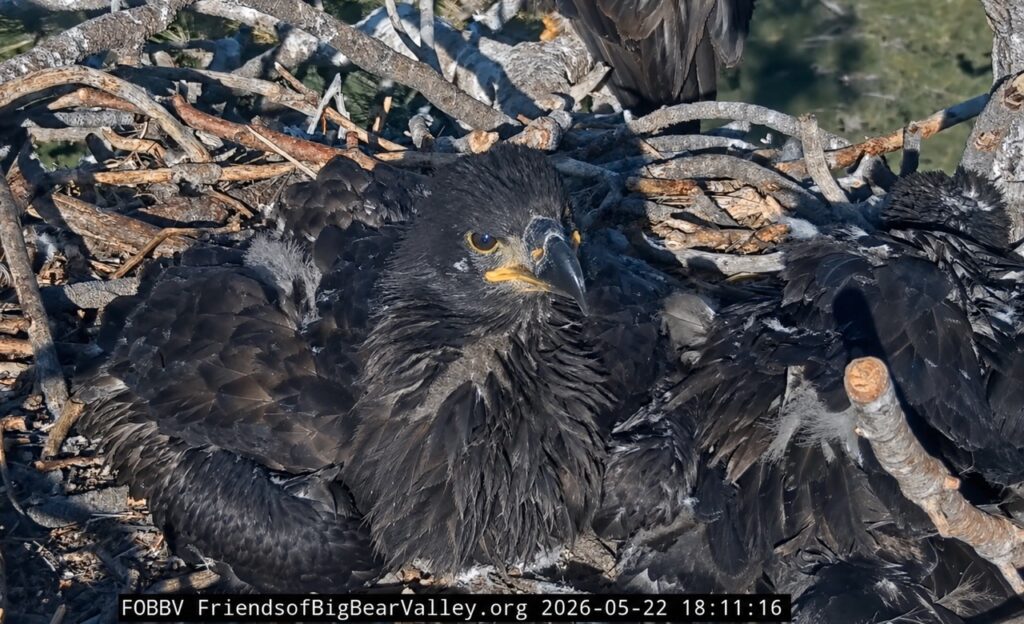
Now comes the harder part: letting them become eagles. For viewers, that may be the most emotional shift of all. The nest will not always look the way it did when the eaglets were small. The family routines will change. The young eagles will move farther, call from different places, and eventually disappear into a life beyond the cameras.
But that is not a sad ending. It is the goal. Sandy and Luna were never meant to stay in the nest forever. They were meant to rise from it. And when that first leap finally comes, the Big Bear eagle nest will not be losing them. It will be doing exactly what a nest is built to do. It will send them into the sky.
Frequently Asked Questions About Sandy and Luna After Fledging
What does fledging mean for Sandy and Luna?
Fledging means one of the eaglets has taken a first true flight away from the nest.
Will Sandy and Luna leave the Big Bear eagle nest right after fledging?
Not right away. Newly fledged bald eagles often stay near the nest area for several weeks.
Will Jackie and Shadow still feed them after they fledge?
Yes. The parents will likely continue providing food while the fledglings learn to survive.
How long does the post-fledging dependence period last?
It varies, but young bald eagles often depend on their parents for several weeks after fledging.
Will the siblings stay together after leaving the nest?
Probably not long-term. Young eagles usually follow their own paths once they become independent.
When will they get white heads?
Bald eagles usually develop their full adult white head and tail around five years old.
Could they come back to Big Bear Valley someday?
Yes, they could return to the broader region as adults, though probably not to Jackie and Shadow’s exact nest.
Are Sandy and Luna banded or tracked?
There is no public tracking map for them. Banding or tagging requires permits, trained professionals, and safe access.


