
Live Great Horned Owl Cams
Ellis GHO Nest Cam
active March-June
Wildflower Great Horned Owl Cam
active Feb-May
Description
Size: 25 inches (64 cm)
Weight: 2-3 1/4 lbs (906-1472g)
Migration: Partial Migrant
Habitat: Most forst types, grassland, shrubland, and rocky areas with steep gorges
Population: Common
About Great Horned Owls
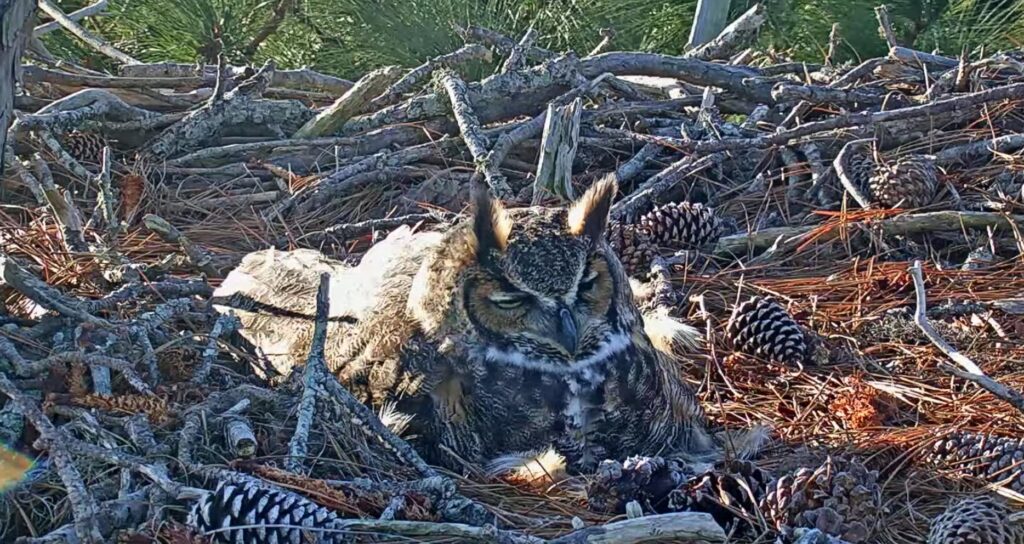
This large, mainly nocturnal, owl has large erect ear tufts, and its gray – mostly brown plumage is mottled above and barred underneath, helping it roost virtually undetected during daylight hours. It’s mostly commonly seen with rust-brown facial disks and a white chin and throat. Occuring throughout North and South America, from the most northern treeline and south to Chile, the Great Horned Owl occupies the widest habitat range of any owl in the world. This is because it takes a wide vareity of prey and will use virtually any nesting site, including rock faces and old buildings that offer sufficient cover.
When Great Horned Owls nest:
Great Horned Owls are one of the earliest to begin breeding, they often start to lay eggs in late January, when there is still snow on the ground.
What They Look Like:
They can vary greatly in color from almost white (in the far north), to brown and grays farther south. They are heavily mottled and streaked birds with a distinctive white throat. The ear tufts are prominent as the large yellow eyes.
Where Great Horned Owls live:
They inhabit a range of habitats including deciduous and mixed woodland, open country, and occasionally suburban parkland.
What Great Horned Owls eat:
They feed on rabbits, lizards, frogs, and birds. They are capable of taking birds up to the size of a crow.
Latest Posts:
- Athena the Great Horned Owl Lays Second Egg at Wildflower Center NestThe quiet rhythm of the Wildflower Center owl nest shifted again on March 9 when Athena the Great Horned Owl revealed a second egg beneath her. Just over four days after laying the first egg of the 2026 season, Athena added another to her growing clutch at the Lady Bird Johnson Wildflower Center in Austin, Texas. The moment marks another milestone for one of the most closely followed owl nests in North America.
- Athena the Great Horned Owl Reveals First Egg of 2026 at Wildflower Center NestThe quiet hours of early morning brought a moment many wildlife watchers had been hoping for. After weeks of occasional visits, Athena the Great Horned Owl revealed the first egg of the 2026 nesting season at the Wildflower Center owl cam in Austin, Texas.
- Great Horned Owl Takes a Morning Bath | Arizona Wildlife Live Cam
- Video – Birding Buzz: Great Horned Owls Wow Viewers At KNF NestDon’t forget to subscribe to email updates if you have not already done so! ❤️ In this video you will hear the sounds of Great Horned Owls hooting around and checking out the KNF E-3 Bald Eagle nest. They spend a good amount of time here(at least 30 minutes) before flying off into the night.…
- PIP Spotted, Hatch In Progress! – Wildflower Great Horned Owl Live CamA PIP was spotted early this morning after Athena left for a short break. From the view a pip can be seen at the top of the egg and also on the back side it looks like maybe a much larger crack. We could see a hatch today! Stay tuned, don’t forget to sign up…
Interesting Fact:
Great Horned Owls are the largest of the eared owls.
Great Horned Owl
What is a pip?
A pip hole is a tiny hole that the eaglet inside the egg makes with its “egg tooth” (a sharp little point at the end of its beek) in the outside shell when it first starts to hatch.
Great Horned Owl Ear Tufts:
Several owls, including the Great Horned Owl, have prominent ear tufts or “horns”, as they are also called. The function of these tufts remains disputed. Some argue that they aid in daytime camouflage, breaking up the shape and helping it blend with its perch. Others believe that the tufts are used for behavioral signaling and species recognition. What appears clear, however, is that they have no role in hearing.