
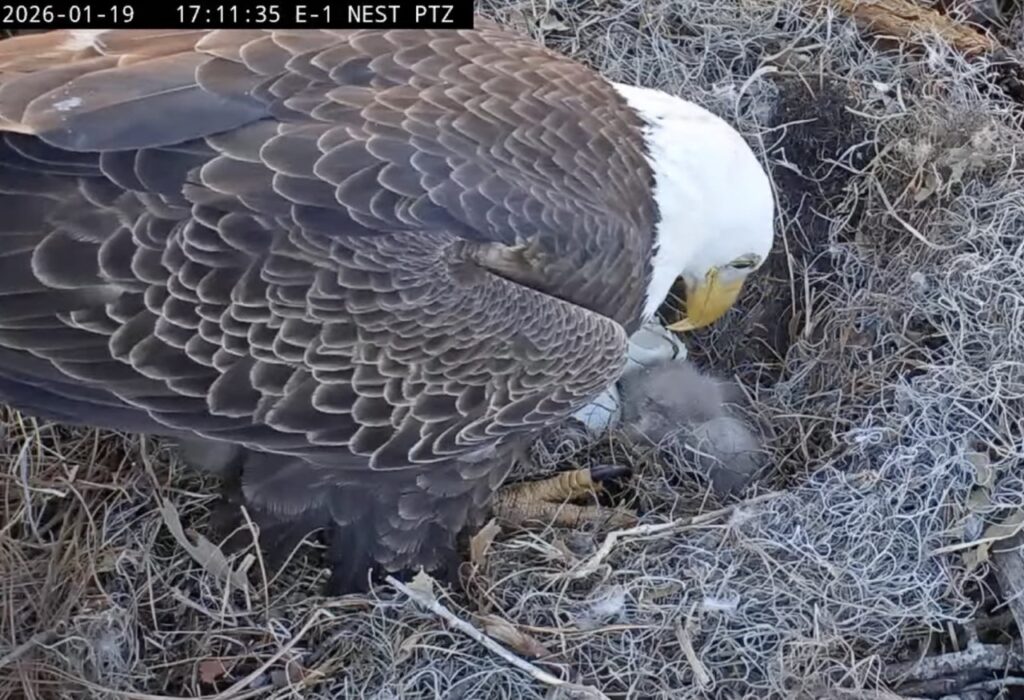
The KNF E-1 bald eagle nest reached an exciting milestone today as the first egg officially hatched. What had been days of quiet incubation and careful watchfulness suddenly shifted into a brand-new chapter, one marked by tiny movements and new life beneath a protective parent.
For those who have been following closely, this moment felt both anticipated and deeply rewarding.
Watch Live ← Nest Cam
A Subtle Change Reveals New Life
At first glance, the nest looked much the same as it had in recent days. The adult eagle remained low and attentive, carefully positioned over the nest bowl. But beneath those steady feathers, something had changed.
The first egg had hatched, revealing a small, fragile eaglet tucked close for warmth. The parent’s posture reflected that shift immediately, with gentle adjustments made to protect the newly hatched chick while still keeping the remaining egg secure.
Receive updates like this one in your email inbox. Sign up for our newsletter. 🦅
From Egg to Eaglet at E-1
Hatching is rarely dramatic. Instead, it arrives quietly, almost easily missed unless you know what to look for. Subtle movements, careful repositioning, and longer pauses all signal that the nest is no longer holding only eggs.
At the KNF E-1 nest, those signs came together today as the first eaglet made its entrance into the world. From this point forward, the focus will gradually shift from incubation alone to feeding, brooding, and constant care.
When Might the Second Egg Hatch?
The second egg at the KNF E-1 nest was laid on December 17, which helps give us a general idea of what may come next. Bald eagle eggs typically hatch after about 35 days of incubation, though exact timing can vary.
Based on that timeline, the second egg could hatch anytime soon, potentially within the next day or two. As always, nature follows its own schedule, but the nest is clearly entering a very active and watchful period.
A New Phase Begins
With the first eaglet now present, the rhythm of the nest will begin to change. Feedings, careful brooding, and constant adjustments will become part of the daily routine as the parent balances protecting both the chick and the remaining egg.
These early hours and days are especially important, making each quiet moment at the KNF E-1 nest meaningful to observe.
A Nest Full of Promise
The arrival of the first eaglet marks a hopeful turning point for the KNF E-1 nest. What was once a story of patience and waiting is now a story of growth and care.
As viewers continue to watch, attention naturally turns to the remaining egg and the possibility of another hatch soon. Each visit to the nest now carries a sense of anticipation, as this family’s season truly begins.
This live streaming experience has been provided by the USFS.
Frequently Asked Questions
When did the first egg hatch at the KNF E-1 Bald Eagle nest?
The first egg hatched on January 19, 2026, marking the arrival of the season’s first eaglet at the KNF E-1 nest.
How many eggs were laid at the KNF E-1 nest this season?
Two eggs were laid at the KNF E-1 nest during this nesting season.
When was the second egg laid?
The second egg was laid on December 17, which helps estimate when the next hatch may occur.
When might the second egg hatch?
Bald eagle eggs typically hatch after about 35 days of incubation. Based on that timeline, the second egg could hatch very soon, possibly within the next day or two, though exact timing can vary.
What happens at the nest after the first egg hatches?
After the first eaglet hatches, the parent focuses on brooding the chick for warmth while continuing to incubate the remaining egg. Feeding and care gradually increase as the eaglet gains strength.
Is it normal for eggs to hatch on different days?
Yes. Bald eagle eggs often hatch one or more days apart, depending on when incubation began for each egg.


