
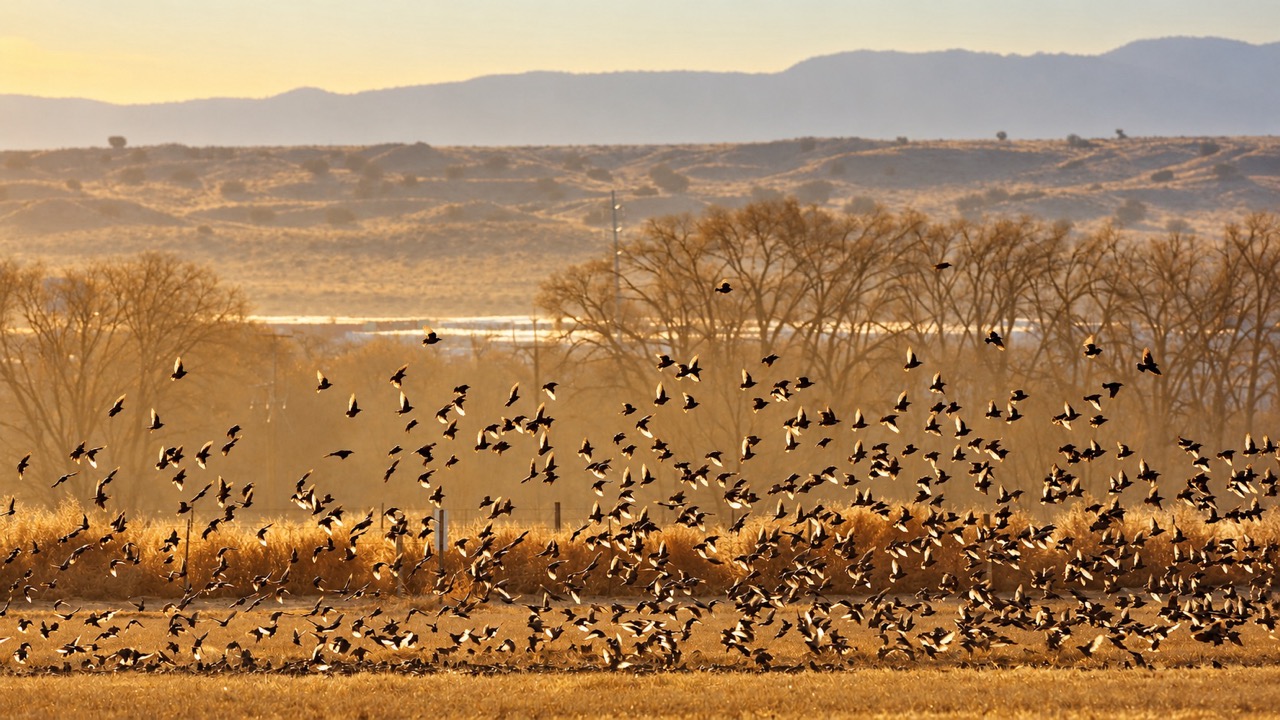

Photo: “2017 Valle de Oro NWR Photo Contest 3rd Place: Landscapes” by U.S. Fish & Wildlife Service Southwest Region, Public Domain Mark.
More than 600 million birds were in flight across the United States on the night of September 26, 2026, as a massive wave of fall bird migration moved south across the country. And most people never saw it.
The huge movement took place largely after dark. BirdCast, a project led by the Cornell Lab of Ornithology, uses weather radar to detect birds moving through the night sky and estimate how many are flying overhead. For anyone who stepped outside the next morning and suddenly noticed unfamiliar birds in the trees, the answer may have been thousands of feet above them just hours earlier.
Fall Bird Migration Happens Mostly at Night
One of the most surprising things about fall bird migration is how much of it happens while people are sleeping. Many songbirds and other migratory species travel after sunset. Birds often begin moving about 30 to 45 minutes after sunset, with some of the heaviest migration occurring a few hours later.
That means a quiet backyard at sunset can have an enormous stream of birds passing high overhead later that night. Migrating birds can also travel surprisingly high. Depending on weather, geography and the species involved, some migrants may fly thousands of feet above the ground. On heavy migration nights, the sky becomes an invisible wildlife highway.
Weather Radar Can See Migrating Birds
The same weather radar network used to track rain and thunderstorms can also detect enormous numbers of migrating birds. BirdCast analyzes data from the U.S. weather surveillance radar network to show where nocturnal migration is occurring, how intense it is and which direction birds are traveling.
On BirdCast migration maps, brighter areas show regions experiencing heavier bird movement. Directional arrows can also show where the birds are headed. The technology reveals something that would otherwise be nearly impossible to appreciate from the ground: enormous rivers of birds crossing the country after sunset.
Which Birds Are Moving South Right Now?
Late September falls near the heart of fall migration for many birds across the United States. Warblers, thrushes, vireos, sparrows and other songbirds may all be moving through different parts of the country during this time.
The exact species depend heavily on location. A bird passing through Minnesota or Wisconsin in late September, for example, may later travel through the southern United States before continuing toward Mexico, Central America, South America or the Caribbean. Some migrants may remain in an area for only a short time. After traveling overnight, birds often spend the following day resting and feeding before continuing their journey south.
That can make the morning after a major migration night an especially interesting time to check trees, parks, wooded areas and backyard feeders for visitors that were not there the day before.
Why Do So Many Birds Leave at Once?
Bird migration does not happen at the same pace every night.
Weather can open and close the gates.
Birds often wait for favorable conditions before beginning another part of their journey. Helpful winds can give them a push south, while rain or strong headwinds may cause birds to remain on the ground. That is why migration can seem fairly quiet for several nights and then suddenly explode.
BirdCast recorded an even larger migration event in September 2025, when more than 1.2 billion birds were detected moving across the United States in a single night. Researchers said favorable weather combined with the peak of fall migration helped produce that extraordinary flight. The latest 600-million-bird movement is another reminder of just how much wildlife can be traveling overhead without ever being noticed.
A Simple Way to Help Migrating Birds
Night migration also comes with danger. Artificial lights can attract and confuse birds traveling through unfamiliar areas, while glass windows can become deadly obstacles. BirdCast encourages people to turn off unnecessary lights during migration and take steps to reduce the risk of window collisions.
Even closing blinds or curtains and switching off outdoor lights when they are not needed can help darken the nighttime landscape. And if you wake up one morning and notice a few unfamiliar feathered guests hopping through the trees, take another look. They may have just finished a journey that began hundreds of miles away.
Track Bird Migration Near You
BirdCast offers live migration maps during spring and fall that show where birds are moving across the United States in near real time. The service is active during fall migration from August 1 through November 15. You can also use its local migration dashboard to see estimated bird movement for your state or county.


Love birds. Feed them year around. Great entertainment 🐦
I clicked on the link for Live Migration maps and put in my City. It was very interesting. This is a cool websight thanks HNF 😃
Great info, thanks!
thanks…I saw a key of geese…