
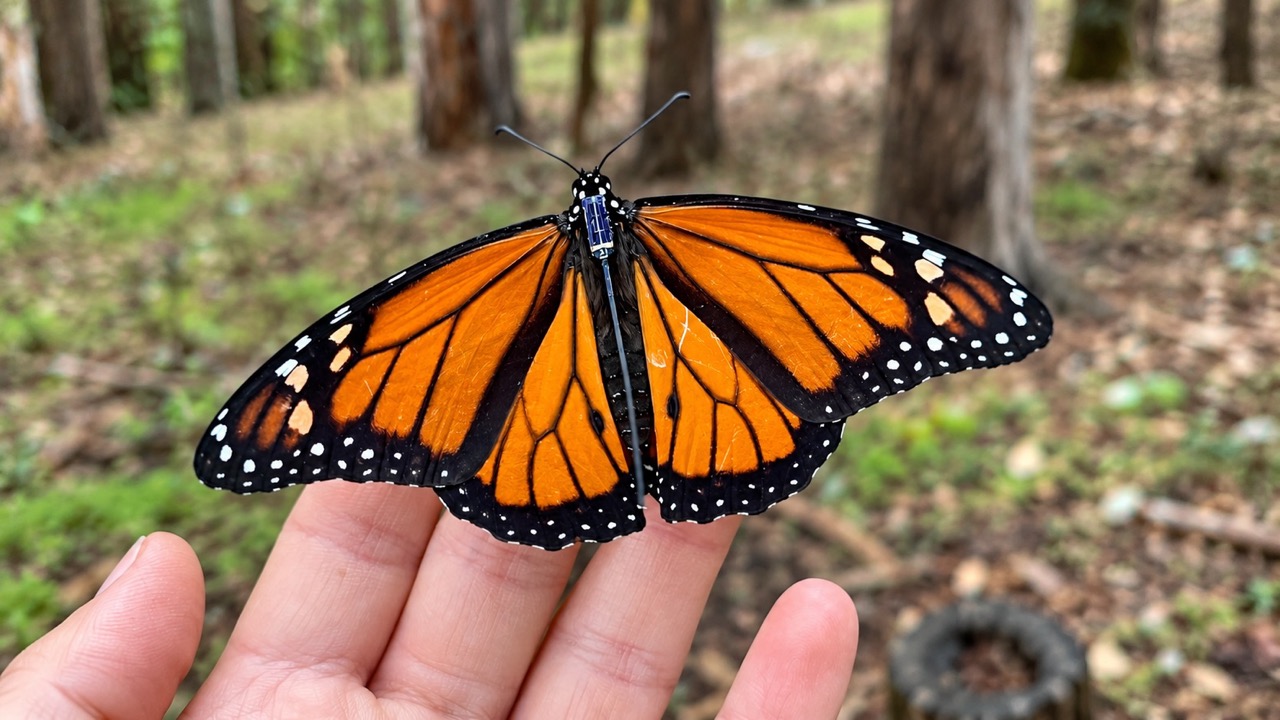

A monarch wearing a BlūMorpho tracking tag is released at Moran Lake County Park in November 2025. Photo: Elena Oey, Point Blue.
On September 22, 2026, New Hampshire Audubon shared an unusual update in monarch butterfly tracking: butterflies are now flying south while carrying tiny solar-powered tracking tags on their backs.
And one of them has already traveled more than 1,500 miles.
The monarch, nicknamed BetaTest, left Belmont, New Hampshire, headed west, crossed Lake Michigan and reached the Mississippi River within about 30 days, according to New Hampshire Audubon. Another tagged monarch named Mike traveled south and was last detected near the southern edge of Georgia.
The tiny devices are giving researchers something they have long wanted: a much closer look at where individual monarch butterflies actually go during their enormous seasonal journeys.
A Tracking Tag Lighter Than a Grain of Rice
The device riding on the butterfly’s back is called a BlūMorpho tag. It weighs just 60 milligrams, or 0.06 grams, making it lighter than a grain of rice. The tag contains no battery. Instead, a tiny solar panel powers the transmitter whenever enough light is available, according to Cellular Tracking Technologies, which developed the device.
Researchers carefully attach the tag to the monarch’s thorax. Traditional monarch tagging usually involves placing a small numbered sticker on a butterfly’s wing. That method can tell researchers where a butterfly started and, if somebody later finds and reports it, where it ended up.
The new tags can provide many more points along the journey. Monarch Watch says the technology can reveal more precise locations in near real time, opening a new window into how individual monarchs travel during both fall and spring migration.
How Monarch Butterfly Tracking Works Without GPS
You may see these devices described as tiny GPS backpacks, but that is not quite how the current BlūMorpho system works. The tag itself is an ultra-light solar-powered radio transmitter operating in the same 2.4 GHz range used by Bluetooth. It can be detected by compatible wildlife receivers and by participating phones and other devices.
The tiny tag sends out its unique signal. When that signal is detected by the tracking network, researchers gain another point along the monarch’s route. That is what makes this new form of monarch butterfly tracking possible without a traditional GPS receiver and battery.
For an insect that weighs only a fraction of an ounce, eliminating a heavy battery is what makes this kind of monarch butterfly tracking possible.
Your Phone Can Help Track a Monarch
There is another unusual part of the project.
Ordinary smartphones can become part of the monarch butterfly tracking network.
The free Project Monarch Science app uses a phone’s Bluetooth and location services to detect nearby BlūMorpho tags. Those detections can then help researchers build a map showing where individual butterflies have traveled.
The more participating phones spread across the migration route, the greater the chance a tagged butterfly will be detected. Instead of scientists needing a receiver everywhere a monarch might fly, thousands of people carrying phones can potentially help fill gaps in the journey.
Scientists Want to Know How Monarchs Cross the Great Lakes
The new technology could be especially interesting around the Great Lakes. Researchers and conservation groups in northern Michigan want to know whether monarchs follow particular routes around the lakes or whether some fly directly across large stretches of open water.
The Sleeping Bear Wildlife Fund has been tagging monarch butterflies in northern Michigan through Monarch Watch. The group hopes more advanced monarch butterfly tracking can eventually reveal migration bottlenecks and important resting areas around the region.
One question is whether butterflies moving between Michigan’s Upper and Lower peninsulas funnel through areas near the Straits of Mackinac or follow other routes along the lakes. BetaTest’s trip already shows how surprising those routes can be. The New Hampshire monarch traveled west and crossed Lake Michigan before continuing toward the Mississippi River.
Hundreds of Monarchs Have Already Carried the Tiny Tags
The technology is moving beyond a handful of test butterflies. Monarch Watch reports that more than 600 BlūMorpho transmitters were deployed during the 2025 fall migration and into the spring 2026 migration season.
Of 30 monarchs tagged by Monarch Watch in Kansas during fall 2025, 10 were later detected in Mexico and six were detected inside overwintering sanctuaries. Those detections demonstrated that the tiny tags could continue providing useful information over extremely long journeys.
This fall, New Hampshire Audubon is adding another group to the experiment. Fifty monarchs are being tagged around Concord and Great Bay, with half carrying BlūMorpho tags and half carrying tiny transmitters connected to the Motus wildlife tracking network.
Why Tracking One Butterfly Matters
Scientists already know the broad outline of monarch migration. Eastern monarchs travel south toward Mexico during fall, sometimes covering thousands of miles.
What is much harder to see is the journey of one individual butterfly.
Where does it stop?
Does it follow a shoreline?
Does it cross a Great Lake?
How long does it remain in one feeding area?
Which patches of habitat become important refueling stops?
Detailed monarch butterfly tracking could help researchers identify locations where milkweed, wildflowers and other habitat are especially important. That can turn a tiny signal from a butterfly’s back into information that helps determine where conservation work could have the greatest impact.
A Butterfly-Sized Window Into Migration
A monarch carrying a transmitter weighing just 0.06 grams would have sounded almost impossible not long ago. Now researchers can watch individual butterflies move hundreds or even thousands of miles across North America.
And in some cases, a phone sitting in someone’s pocket may help record the next step of the journey. For a creature famous for disappearing over the horizon every fall, that tiny solar backpack is making the invisible parts of the trip a little easier to see.


What a time to be alive – to see technology like this! And used for a wonderful purpose.
That’s quite fascinating 🦋🧡🖤
An amazing invention…🦋…👋🏻
that is amazing